Below is an updated article regarding the Midtown development process written by Duncan Galloway of the OLRA. In it you will find a summary of recent events, the political situation and the involvement of the Province in the planning process along with a review of the main concerns (density, traffic, lack of facilities, lack of adequate family accommodation) stated by residents associations and other parties.
Please, after reviewing the article, consider writing to the Province and your local MPP to ensure your views are noted. “We Love Oakville” has created a letter that you can link to here…. New/Mode | Make your voice impossible to ignore. There are also plenty of resources to help you better understand the situation on the “We Love Oakville” website.
The article can also be read on pdf here:Midtown – the full story
- In our Spring newsletter we provided an overview of the context and status of Midtown planning. Earlier, in January many of you sent emails and letters to the Mayor and Council expressing our concerns at the draft Midtown plan, asking for better explanations of height and density, lower population targets, building heights kept to 20 storeys, integration of mid rise buildings, better environmental standards and so on.
- Across Oakville thousands of emails and letters were sent. This made a huge difference, as we will explain below. Together, we are heard. In this article we will provide the most current update on Midtown, an explanation of the forces at work, and show why your attention and communications are still needed and critically important.
- Some background: while you wait at the traffic lights by the Go station on Trafalgar Road, you can contemplate Oakville Midtown – because you are right in the middle of it. Here is the map of Midtown: 103 hectares, of which only 43 hectares can be built on – the rest is railway, roads, hydro etc.
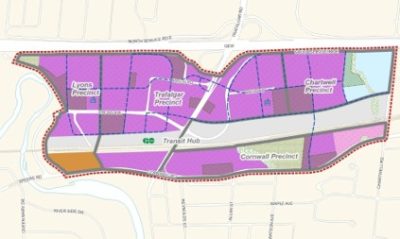
- This little 1 square kilometre has been designated the leading strategic growth area for Oakville; it will become Oakville’s urban core centred around transit with the highest density of population in Oakville.
- What kind of city centre will this be? Different players are involved, and each have their own goals and agendas.
- First and foremost: Future Midtown residents, who should be able to live in comfort in a beautiful tree lined, friendly, safe neighbourhood, with easy access to shops, green spaces, neighbourhood schools for their children, accessible health care for the whole family, and the ability to walk, cycle and travel easily to work, study and play. OLRA and the We Love Oakville group of resident associations have been advocating for a liveable Midtown for over a year, and continue to do so.
- Second: Landowners and developers: Their primary focus is to build for maximum return on their investment in land and costs of development. Simple maths dictates that the more housing units they can place on a hectare of land the greater their return. If the project is so constrained that it becomes unprofitable or too expensive, they will not build, but rather will sell the land or wait for more profitable conditions to emerge.
- Third: The current Provincial Government. They have declared a “housing crisis”. Ministers announce they will “build, build, build”. Through various laws, policies and agencies they bring great pressure to bear on Midtown planning.
- Fourth: Oakville planning staff. They have to navigate a path between the demands of the provincial government, developers, and what is liveable for future residents. Their role is to develop a high level plan (the Midtown Official Plan Amendment, or OPA) that forms the basis for future development of Midtown through to 2051 and beyond.
- Fifth: Oakville Council. While representing the interests of their respective Wards, they have an overall responsibility to ensure the best possible plan for a liveable Midtown, while addressing multiple issues – traffic, transit, finance and costs, parks, environment, amenities and services, schools and so on.
- Sixth: There is one player that sits behind the scenes but has an outsize influence on all . It is the Ontario Land Tribunal – a provincial government body that adjudicates appeals relating to land use planning. In recent years an iniquitous system has been established in Ontario. It works like this: developers put an initial application for their forest of towers to the Oakville Council who say “No”. Then the developers immediately appeal to the Provincial Government – the Ontario Land Tribunal (OLT). The Housing Minister may, at any time, issue an order (a MZO, Ministerial Zoning Order) overruling the Council and allowing the development to proceed, despite opposition from town planners, council and residents.
- In recent years the OLT has overwhelmingly decided in favour of the developer – 97% of the time according to an analysis of decisions in 2022. Recently, we understand the performance of the OLT is being investigated by the Province Auditor General.
- What does this mix of players, and especially the OLT, mean for our Midtown plan? Basically it comes down to achieving a liveable high density Midtown. We need to make sure the neighbourhood of Midtown is high density and liveable, not hyper-density, overcrowded, cramped and unliveable. Authorities world-wide have a wealth of data showing that overcrowding means a diminished quality of life due to cramped living conditions, noise pollution, severe traffic congestion, mental and health issues arising from lack of personal space, and inadequate access to amenities like parks, community centres, healthcare and schools.
- A simple density number to watch out for is number of people per hectare. A hectare is a square of 100 metres by 100 metres (if you watched the Olympics, that is the 100 metre sprint around 4 sides of a square, or the grassy interior of a running oval).
- The Provincial Government has mandated that Midtown must have, at a minimum, a density of 200 “people & jobs” per hectare, and ideally more. So around 20,000 people and jobs. The standard is to plan for about one third jobs, two thirds residents – so the province minimum is about 130 residents per hectare, or just under 14,000 overall.
- But, as we write this, developers have applications in front of the Provincial Government that are on track to create a hyper-density neighbourhood. For example, Distrikt developments have applications for 11 towers in Midtown which they have appealed to the Ontario Land Tribunal – the density of their 5 hectare development, using their own numbers, is over 2,800 people per hectare! That is hyper-density; eight times Manhattan’s highest density neighbourhoods, and almost eighteen times the Province minimum density requirement. There are 54 landowners and developers in Midtown – currently other developers are sending in their own applications to the OLT with similar unliveable numbers. Total population in Midtown could balloon to over 90,000 people – well over even the highest density in the world (Mong Kok neighbourhood, in Hong Kong).
- The OLT threat drives all planning decisions. While we would love to have a Midtown plan that is a green village of 5 or six storey mid-rise timber buildings and that meets minimum provincial density requirements but not much more, we know that plan would not be “defensible” at the OLT. In other words the OLT would regard the Midtown OPA as unrealistic, and the Minister could grant developers their applications for 40, 60, and 80 storey towers. Oakville Council and the planning staff would lose all ability to manage the development of Midtown as a liveable community snd would lose the ability to obtain community benefits from developers.
- So “defensibility” at the OLT is a key criterion of a good Midtown plan. Oakville planning staff must try to create a plan that has the right balance between liveability and defensibility.
- To make matters worse, most recently the Province’s Ministry of Infrastructure announced they would establish a “TOC” – a Transit Oriented Community – in Midtown, and they would do this together with one favoured developer. What would this mean? We don’t know, because all this is being done in secret with the Provincial Government and their single favoured developer working together, while imposing strict confidentiality and non-disclosure agreements on Oakville staff and Council. Secret financial arrangements between the Provincial government and one favourite developer with unknown impact on our town? Take a look at the We Love Oakville site (ca) to send a letter to the Provincial government to express our concern at this TOC initiative.
- Against this forbidding background, on October 10, 2024, Oakville planning staff presented a workshop to explain and discuss with Council the latest draft Midtown OPA. You can see this presentation on You Tube (Committee of the Whole: Midtown Oakville, October 10). The good news is that, for the first time, we were presented with a draft OPA that, in our view, can evolve into a viable plan for a liveable Midtown. We were provided with transparent explanations and reasons for decisions that make sense. And the density numbers, while potentially high, are more reasonable and also make sense.
- Here are some key points:
- The OPA must commit to the establishment of a CPPS (Community Permit Planning System) that will provide the detailed bylaw structure governing building permits across Midtown and which will enable the town to establish conditions for development permits. In particular it wold allow the town to give developer a “bonus” of additional floors over a threshold height in exchange for the developer providing community benefits. These “bonusing” conditions could support achievement of:
- public transit infrastructure, facilities, services
- public parking;
- affordable housing for a wide array of socio-economic groups;
- Additional parkland above the provincial parkland dedication bylaw
- day care centres;
- integration of office uses in mixed use developments;
- green buildings;
- pedestrian and cycling facilities across the QEW, railway tracks or Trafalgar Road;
- community facilities such as a creative centre, including studio, office, exhibition, performance and retail space, and a library;
- contributions towards a district/renewable heating/cooling/energy system.
- Quite a wish list. In other words the CPPS should add detail to the overall policies of the OPA and should address many of the liveability issues we have been advocating for over the last year. No doubt the development of this CPPS will be closely watched and carefully analyzed and debated in the months to come.
- Not addressed by the CPPS and one of residents’ key concerns is the impact of Midtown development on traffic and congestion on Trafalgar road and around the Go station. The October 10 presentation shows anticipated bridges, new roads and infrastructure that may help. But this infrastructure is not in the power of Oakville – this major investment in road infrastructure depends on investment by others – Halton region, the Province Ministry of Transport, and MetroLinx (the Provincial Government operator of the Go Transit system). The concern is that not one of these bodies seems to be seriously engaged in providing this infrastructure.
- One of the issues we face in Midtown is that the town owns little of the land; so any space for parks, green space and amenities such as libraries, community centres and day care has to be obtained from landowners / developers. That means negotiation – essentially setting density criteria so that if a developer wishes to build more apartments by building higher, they would have to give a community benefit back to the town – in the form of space for a park, floors for a library or community centre, and so on.
- The main tool for negotiation available to the town is to allow a developer to build more density in a given area, up to an overall cap. Schedule L3 of the draft OPA shows the overall cap on density, in the form of FSI – floor space index. Basically with a FSI of 2 a builder can cover the entire plot of land with two floors; with an FSI of 6, six floors. Things get more complicated when taking into account roads, greenways, setbacks, wide sidewalks and so on, but that is the basic idea.
- Oakville planners’ approach is to retain the town’s old OPA policy that maximum heights are capped at 20 storeys. But they would allow a developer to add more storeys in return for providing community benefits to the town (such as the above list). Developers could add additional storeys until they reach the maximum FSI density cap for that area. In this way as development proceeds the town is able to provide key community benefits and liveability
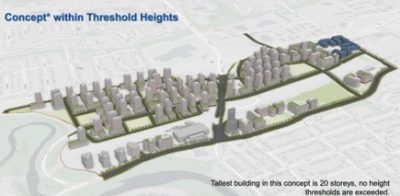
- The October 10 presentation gave some graphics that explained this well. This one shows full development of up to the threshold of 20 storeys assuming no developer wanted to exceed the “threshold” heights of 20, 12 or 10 storeys (depending on location within Midtown).
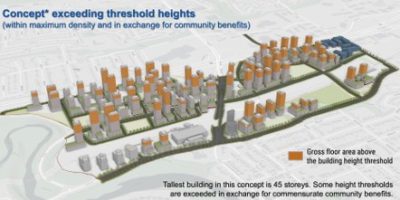
- This second picture shows the maximum that could be built if all the landowners and developers added on extra floors (shown in brown) up to the maximum density allowed for that location. In this case all developers would have provided space, land and or amenities to the town in exchange for permission to build higher.
- What does this mean in terms of numbers of people and overall density of population? One baseline number to bear in mind is a recent study by Watson & Associates to establish the population likely to be in place by 2051. Their study showed a conservative estimate of 29,900 people and jobs by 2051, with an assumption that growth would continue beyond that date. Remember, the province minimum is round 14,000 residents.
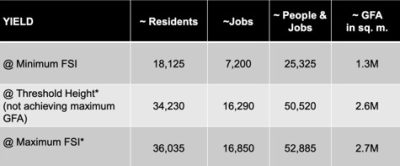
- The draft OPA shows the following
- :

- In other words, if no one built higher than the threshold height of 20 storeys, the minimum population would be about 34,000. If all developers built to the maximum density allowed, population would be about 36,000 residents.
- To put these numbers into perspective, as we said above, unrestricted development based on current developers’ appeals to the OLT could give an unliveable hyper-density of 90,000 residents. High density neighbourhoods in Manhattan of a similar size, such as Upper East Side or Hells Kitchen, have population densities in the range of 30,000 to 40,000. So, this draft OPA plans for a future high density resident population of around 35,000 that is at the top end of high density in North American terms, but liveable and hopefully defensible to the Provincial government at the OLT.
- In conclusion we are cautiously optimistic that this draft OPA can, hopefully, become an OPA that we residents can support. There are lots of details and areas of concern, but overall this is a refreshing and reassuring draft plan. OLRA and the We Love Oakville team will continue to monitor and advocate for the refinement and development of this OPA.
- But – and this is a big but. If developers applications are approved by the Provincial Government at the OLT this draft OPA is meaningless, and we are in a free for all of unrestricted development, hyper-density and little money for community benefits. If the provincial Minister of Infrastructure proceeds with the TOC initiative that would add to the population planned by the OPA.
- Our fight for a liveable Midtown is now to convince the Province that we are all supportive of our town plan, and that we can achieve more than the density they require for housing without their interference and without their preferential treatment to certain developers. And especially we have to convince the Province that their TOC initiative with their favoured developer is not welcome, and not needed.
- We have to speak to power with a loud voice. That means lots and lots of people, across Oakville, speaking out against hyper-density, and speaking out against unrestricted development and the abuse of the OLT system.
- OLRA and other Resident Associations are organizing under the We Love Oakville banner and website to make it easy for all people across Oakville to speak out and be heard. Things will move quickly in the next few months – and indeed may have moved on since this was written. Please look at the website and sign up for updates and emails you can send to politicians and decision makers. Please make your views heard. It is critical EVERY RESIDENT AND THEIR FRIENDS SEND THE Premier emails or we will end up with hyper density on the Distrikt lands.https://win.newmode.net/wlo/savemidtown The future residents of Oakville need you!